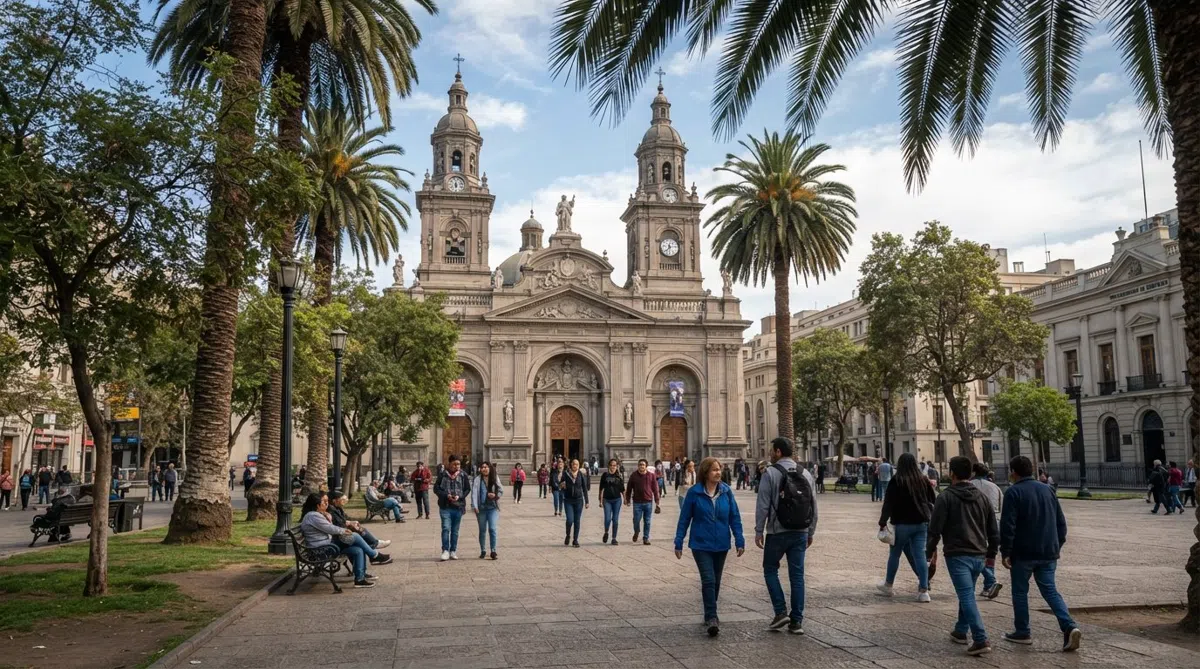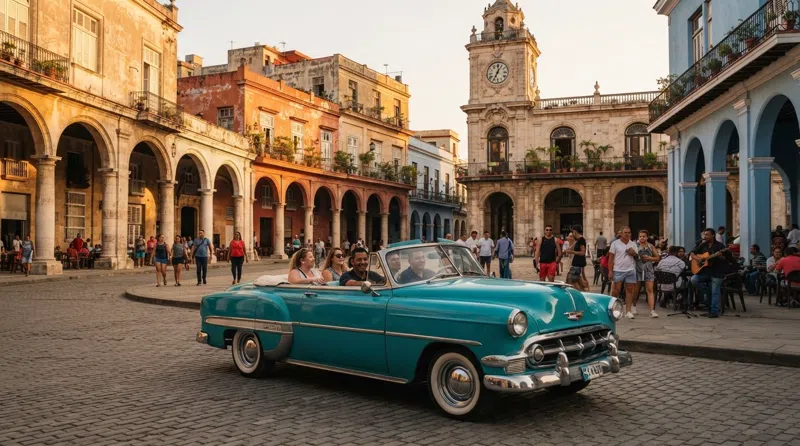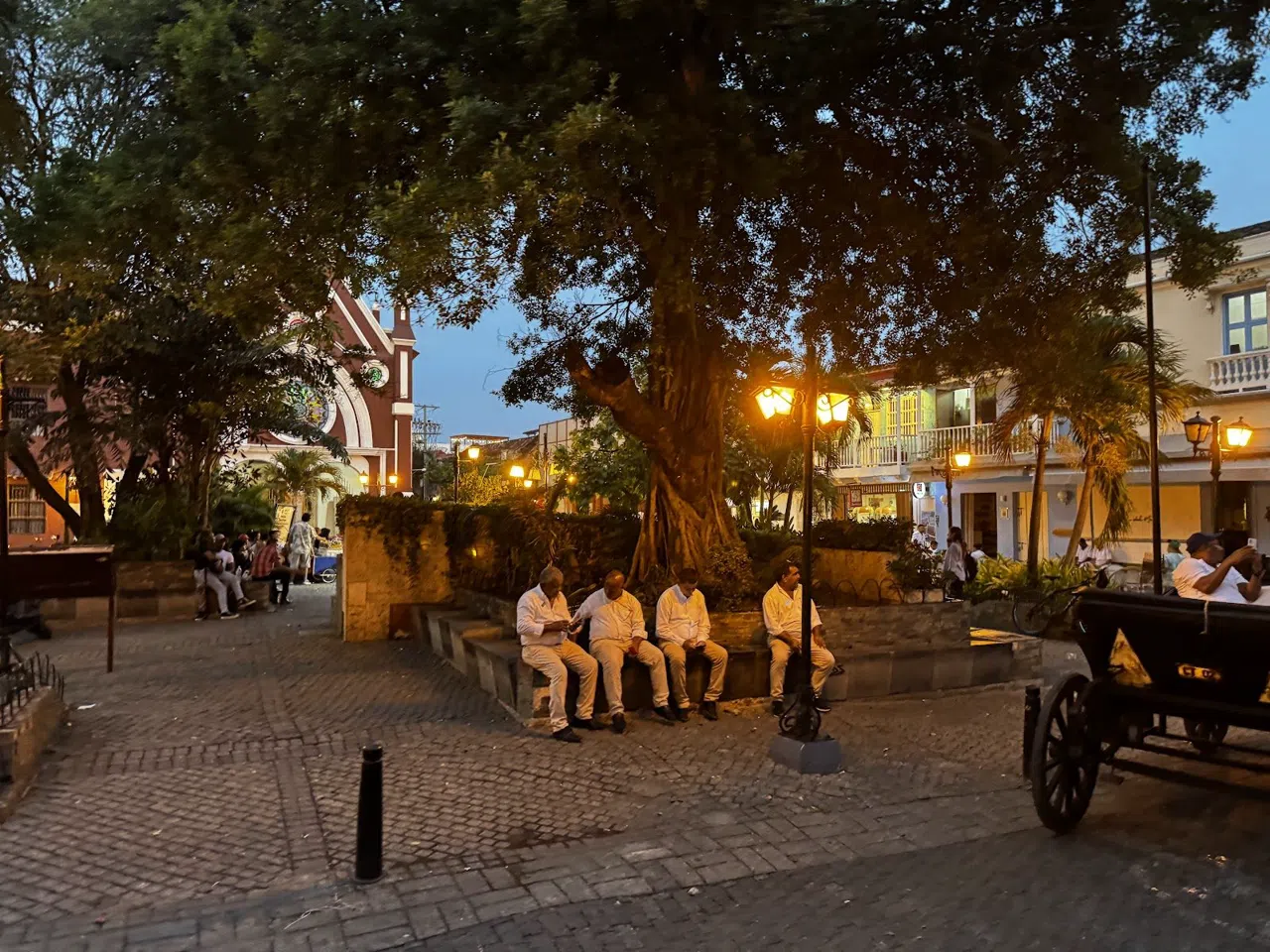

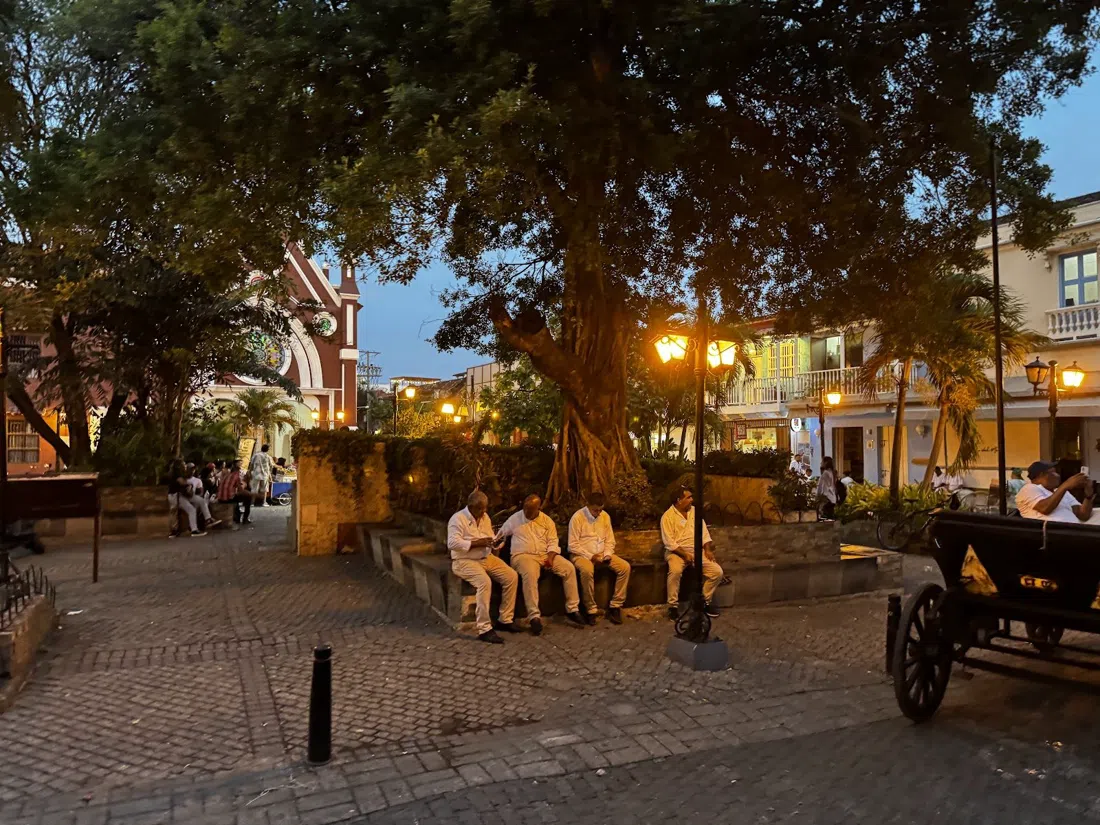
The guides bring their groups through Plaza de San Diego all day, park them under the palms for four minutes of history, then lead them away again. Almost nobody stays for what follows: the terraces thinning out, the balconies holding the last of the light and then losing it, and a trumpet starting up somewhere behind the old convent wall. The building on the far side is a working arts university, so that is a student practising, not a band hired to charm you. It is the quietest of the walled city's great squares after sunset, and sitting in it costs nothing.
A square you are allowed to do nothing in
Plaza de San Diego (San Diego, the northern quarter inside the walls) is small: a rough rectangle of pale paving, a few palms, café tables pushed out from the restaurants that hold two of its sides, and balconies above them. There is no monument in the middle, no ticket office, no door policy and no closing time. That is the whole proposition. You walk in, you sit down, and the square does the rest.
By day it is busier than the photographs suggest. Walking tours assemble here constantly, and guides tend to pause their groups by the palms on the side nearest the arts school, so for stretches of the morning the calm is borrowed. It still compares well with Plaza Santo Domingo a few streets south: fewer tables, less hustle, lower prices, and a scale that lets you hear the person opposite you. If you buy from the vendors working the edges, expect coffee at roughly COP 3,000 to 5,000 and craft pieces from about COP 20,000.
The hour before sunset is when the square turns. The light comes in low, catches the balconies and the lime-washed walls, and the students spill out of the arts school in twos and threes with instrument cases. After dark the terraces stay lit but the through-traffic stops, and the plaza becomes something the bigger squares cannot be: somewhere to stay put for an hour without being sold anything.
As a sight to tick, it takes ten minutes. As an evening, it takes three hours, and that is the correct way to use it.
The convent behind the music
The building that gives the plaza its face is the Claustro de San Diego (San Diego), the old Franciscan convent that now houses the Institución Universitaria Bellas Artes y Ciencias de Bolívar, universally shortened to Unibac. It has been national heritage since 2001, and the courtyard behind the doorway is why the square has the proportions it has.

It is a working campus, not a museum. There is no ticket, no tour and no guaranteed entry. In term time reception will sometimes allow a visitor a quiet look at the courtyard and sometimes will not, and both answers are fair: people are in class. If you are with a group, ask before you cross the threshold, not after. A dozen people walking through a rehearsal is a different event from one person standing in a doorway. The consolation if you are turned away is that you have already had the best of it from the outside, because the music drifting across the plaza at dusk is a practice room, not a programme.
Dinner on the plaza, and the honest alternative
Juan del Mar (on Plaza de San Diego itself) is the square's anchor and, most nights, its loudest table. One operator runs the seafood room, the pizzeria and the Peruvian menu as separate frontages, so treat it as a single address, not three restaurants to choose between. Mains land at roughly COP 60,000 to 120,000, around US$15 to US$30. It takes reservations and groups on +57 312 714 8778; ask for the air-conditioned room if you are more than six and want to talk, and the terrace if you want the plaza. You are paying a premium for the view of the balconies. On a first night in the city, that is a defensible thing to pay for.
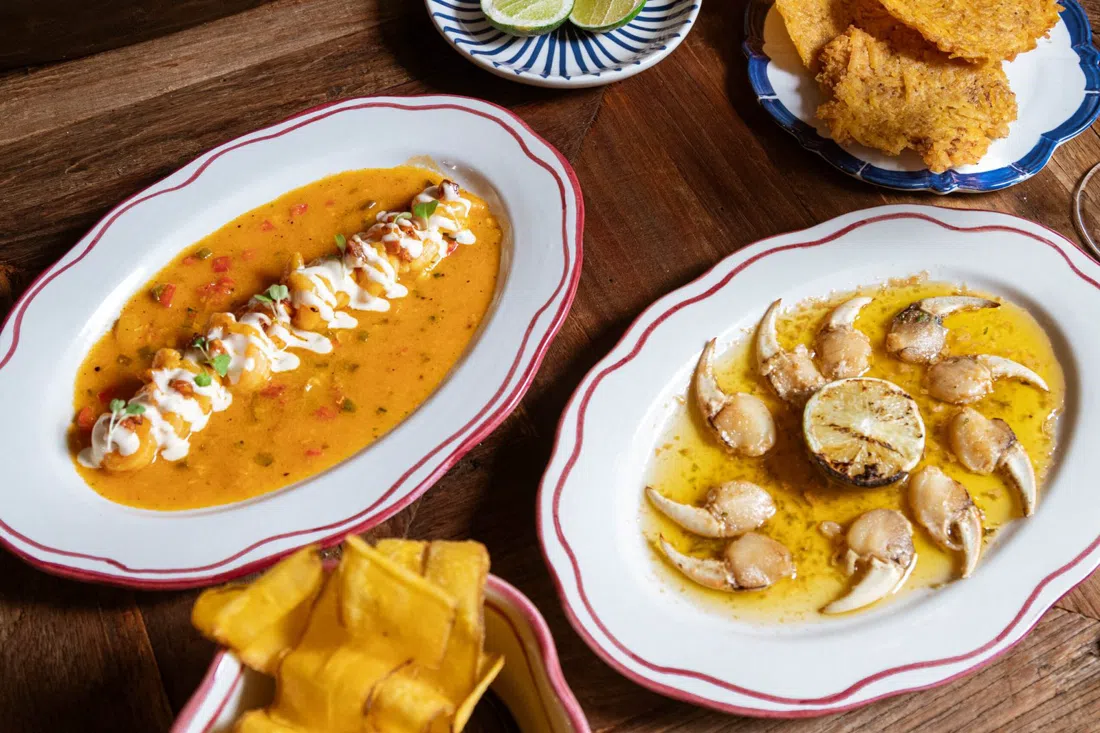
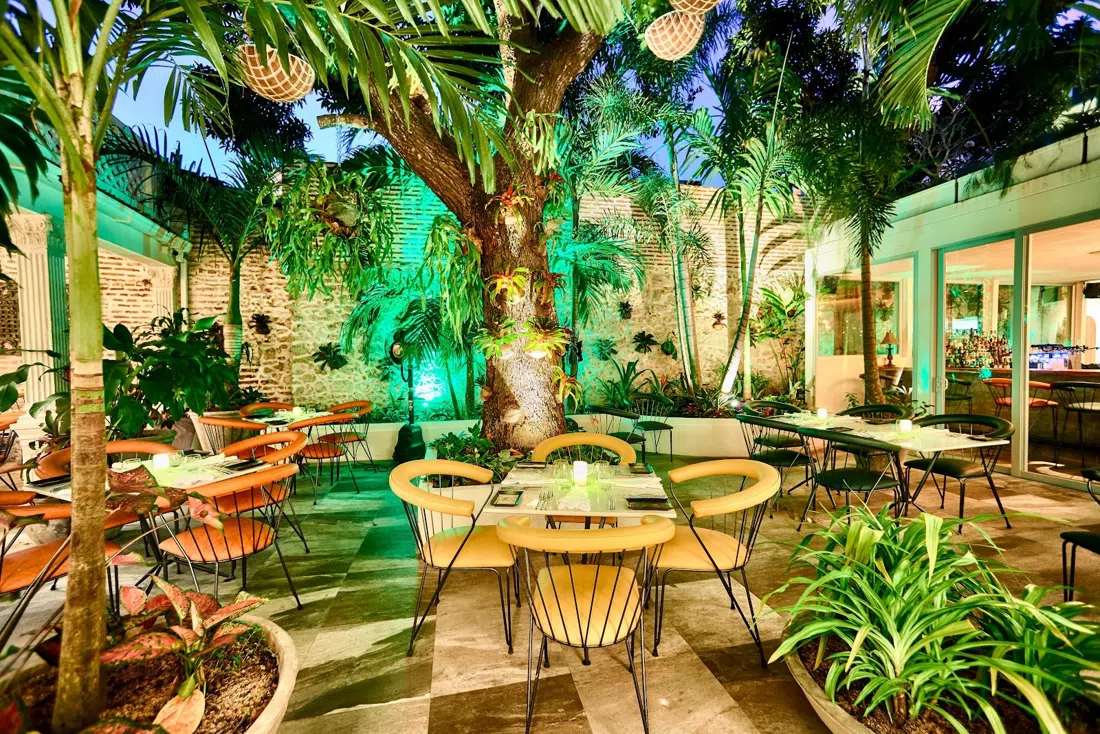
Restaurante Carmen (San Diego, a short walk off the square) is the barrio's serious kitchen and the address that pushed Cartagena toward properly plated contemporary Colombian cooking. It sits at the top of the local price range, tasting menu territory, and it has three distinct zones, a garden patio, an indoor room and a bar, which is what makes it workable for a group and not only a couple. Private events are arranged with the restaurant directly. Book well ahead; this is not a walk-in.
La Cevichería (San Diego, a few streets from the plaza) has been queued since its Bourdain episode and has not stopped. Ceviches run roughly COP 45,000 to 90,000 and it is open daily from noon to 11pm. The room is very small, fine for two or four and awkward for a group of eight, so the trick is timing. Arrive at opening, or mid-afternoon, and the pavement wait disappears; arrive at 8pm and you will stand.

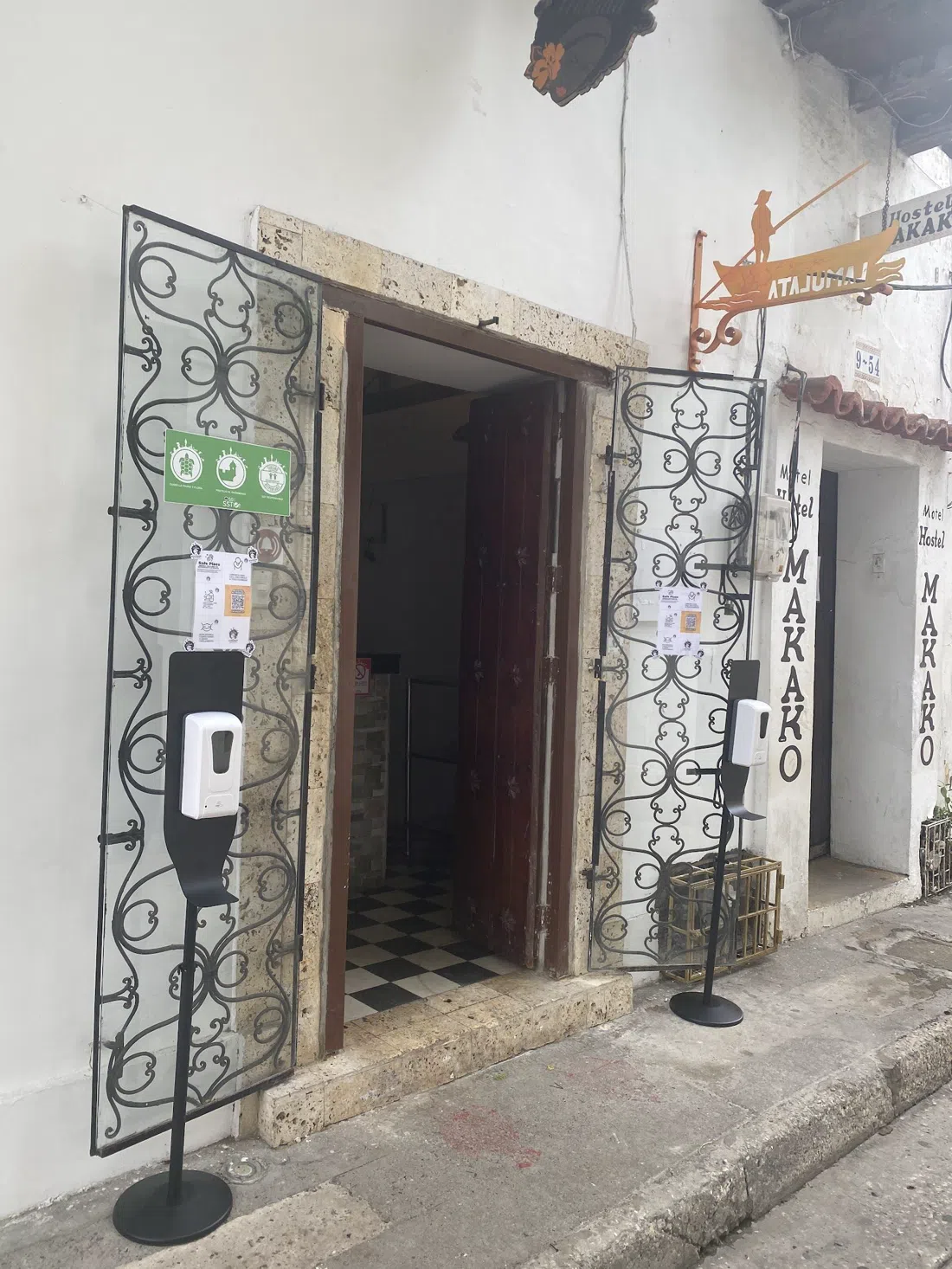
La Mulata (San Diego, five minutes' walk) is the counterweight and the answer to where people eat who are not on holiday. Mains are roughly COP 16,000 to 40,000, it is open Monday to Saturday from 11.30am to 10pm and closed on Sundays, and it takes no reservations. It is strongest at lunch, when it fills with locals. With a group, get there before 12.30pm or accept that you will be waiting.
Where the evening goes after the plates
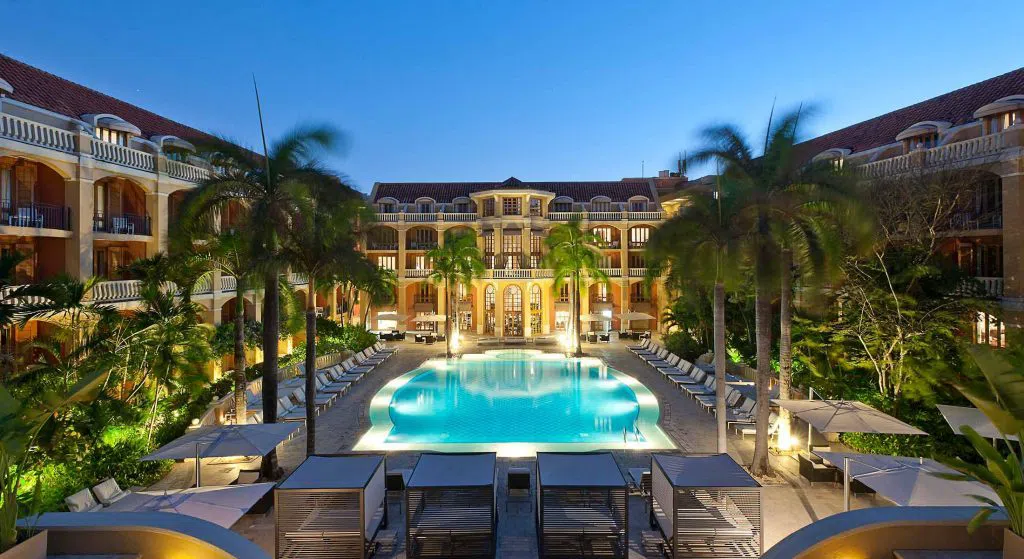
Sofitel Legend Santa Clara Cartagena (San Diego) occupies a converted convent two minutes from the plaza, and its El Coro Lounge Bar is open to non-guests for drinks and dinner. Cocktails are roughly COP 45,000 to 70,000, the dress code is smart-casual, and Saturday salsa nights are live and worth booking for. Larger groups should arrange through the hotel instead of turning up hopefully at the door. The reason to come is beneath the bar: the crypt that fed García Márquez's Of Love and Other Demons. Ask at the bar and staff will usually show you down. It is a strange, cool, quiet five minutes and it reframes the whole quarter.
Townhouse Art Hotel — Rooftop (San Diego) is the nearest real viewpoint to the square, open from 8am to midnight, with a plunge pool and cocktails at roughly COP 40,000 to 60,000. Non-residents must book on WhatsApp, +57 304 355 1068, and this is not a formality: the terrace is tiny, which is exactly why sunset gets taken first and why a group of more than four needs to call ahead.

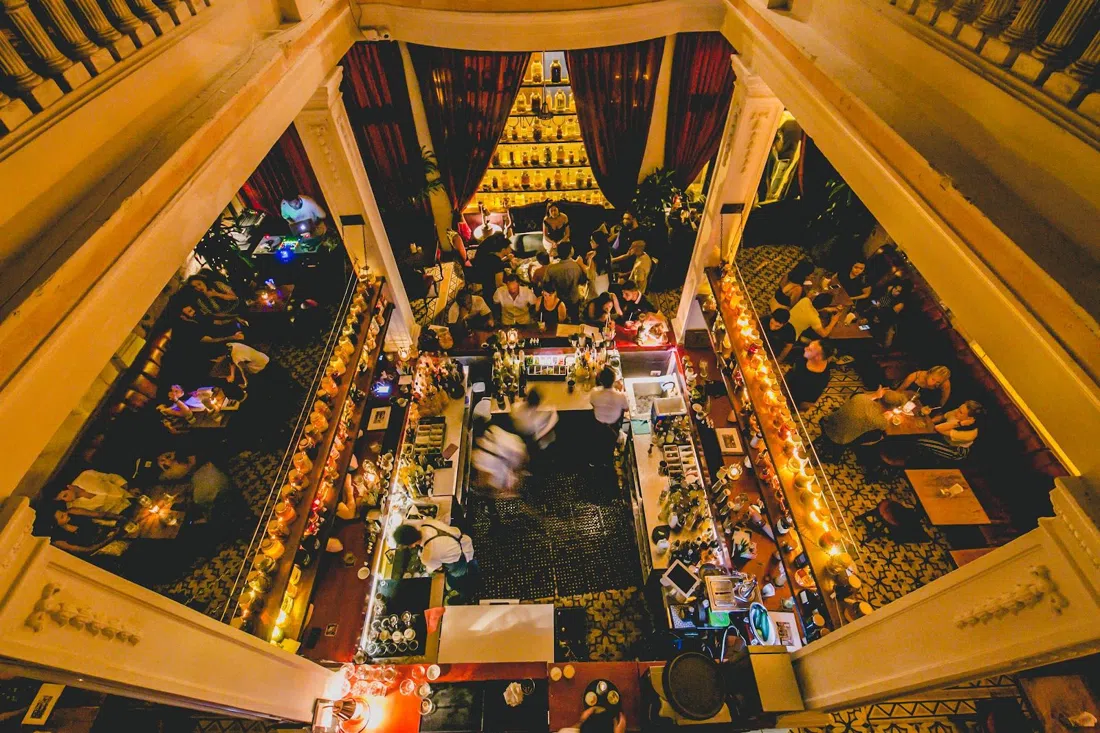
Alquímico (a five-minute walk from the plaza) is the one place in this guide that behaves like a destination bar. It won the Michter's Art of Hospitality Award at The World's 50 Best Bars 2026, it spreads over three floors, and it does not take reservations on busy nights, so queues build after 9pm. Cocktails run roughly COP 45,000 to 65,000. The tactic is to arrive early, start low and move up as the building fills; the rooftop is where a group will actually fit. Its farm-sourced programme funds community projects, which is the part that makes the queue easier to forgive.
The ten minutes on foot that make the evening
Plaza de San Diego is worth building a loop around instead of visiting on its own, and everything below is a short walk.
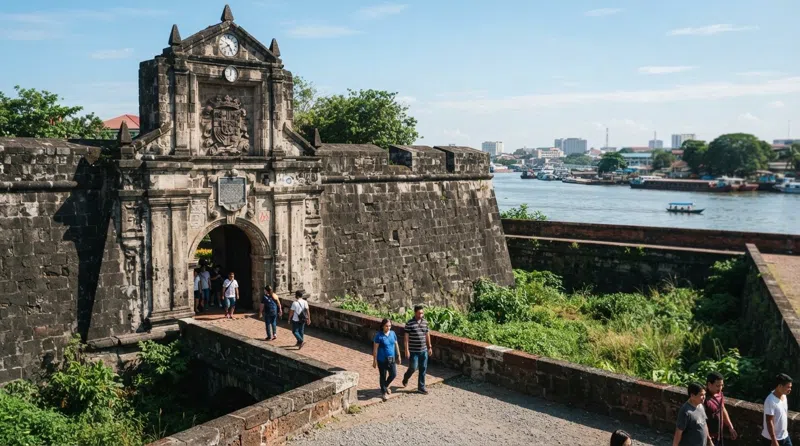
Baluarte de Santa Catalina & Museo de las Fortificaciones (San Diego, on the wall) is the closest piece of rampart to the square and the best place to understand why the plaza sits where it does. The wall walk is free and public, the underground exhibition is small and almost always empty, and it runs roughly 8am to 12pm and 2pm to 6pm, so this is a before-dinner stop and not an after-dark one. A group should go through the vault in batches rather than all at once.
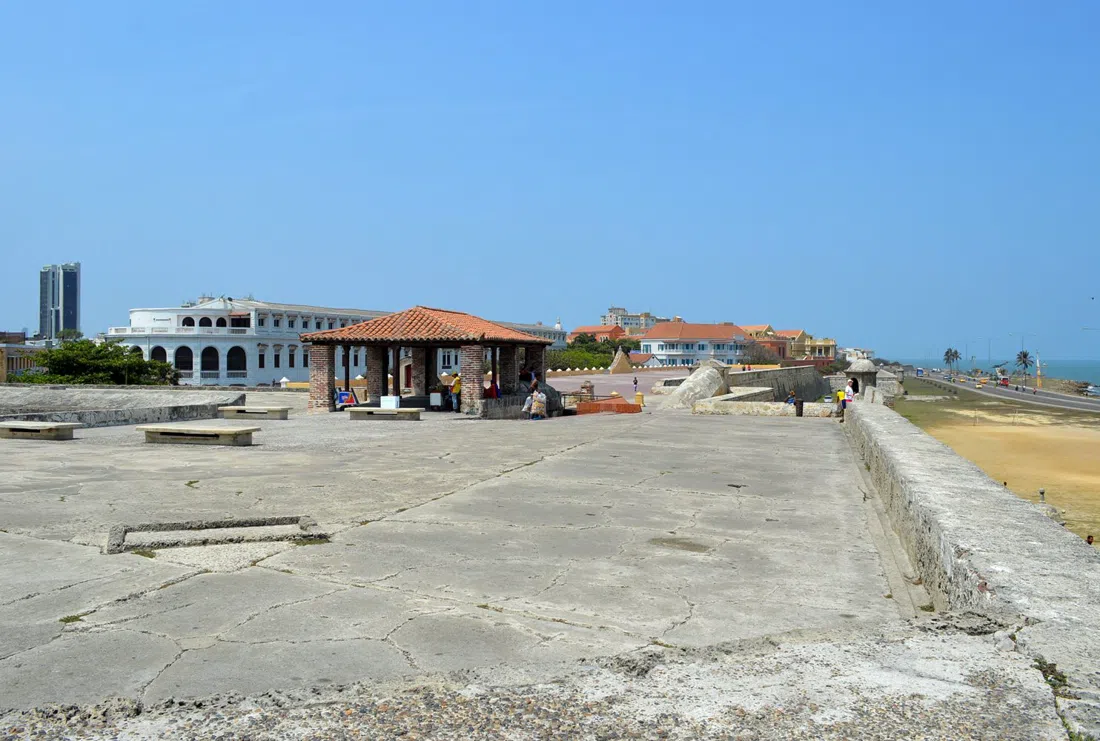
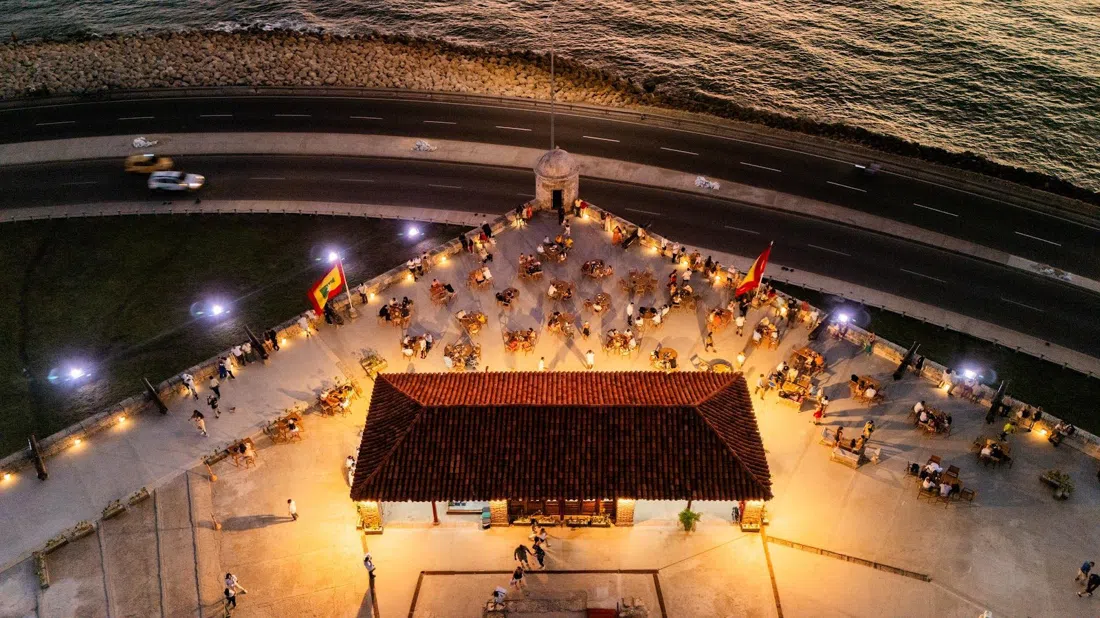
El Baluarte de la Gente (Baluarte de Santo Domingo, on the ramparts) is where to watch the sun go down. Use the current name: the long-running Café del Mar lost its lease, and the bastion reopened in May 2025 run by the Escuela Taller and staffed by its cookery graduates, with takings going back into heritage work. It is open daily 4pm to 11pm, drinks and Caribbean plates sit at mid-range city prices, and the terrace takes groups happily, though sunset seating goes first, so arrive by about 5pm if the view is the point.
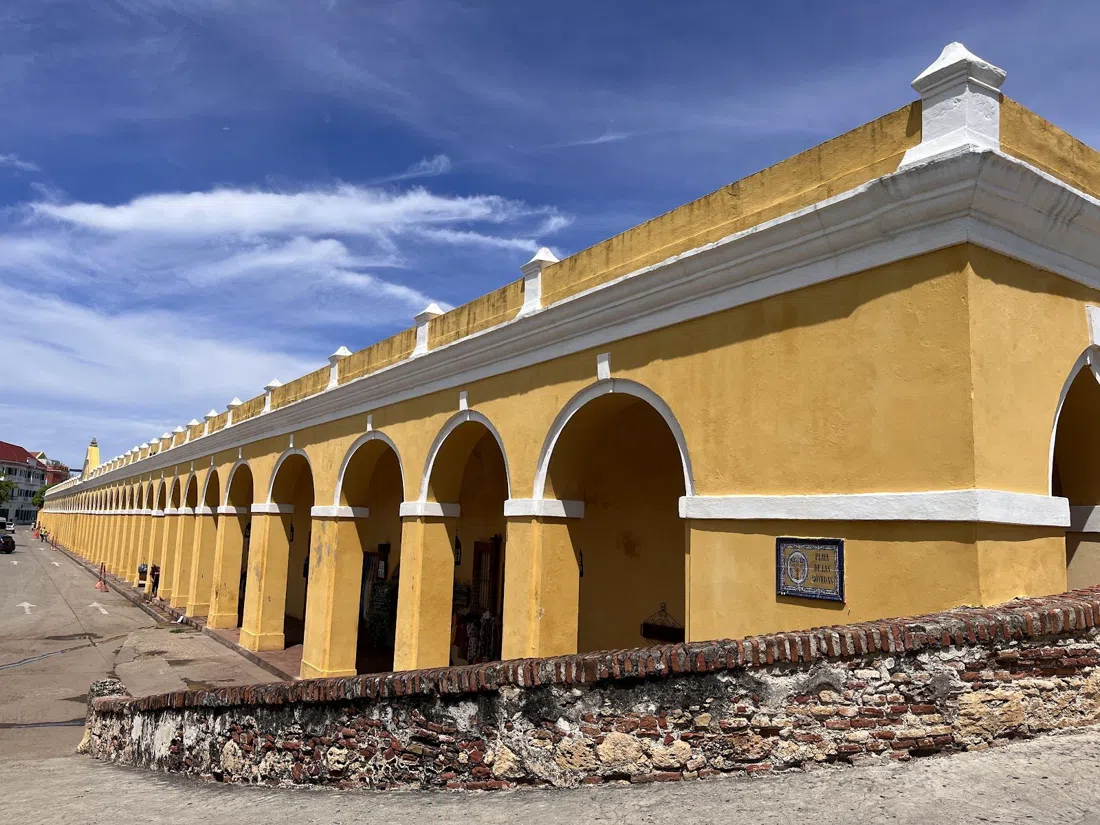
Las Bóvedas (two minutes north of the plaza) is the craft arcade built into the walls, finished in 1798 as powder stores. It is free to walk, there is no door policy, souvenirs start around COP 20,000 and hammocks from COP 80,000 upward, and haggling is expected, though most stalls carry much the same stock, so shop on price and mood instead of hunting for uniqueness. Do it in daylight. The heritage body ETCAR is progressively taking vaults back for refurbishment, so expect a few arches to be shuttered on any given day.
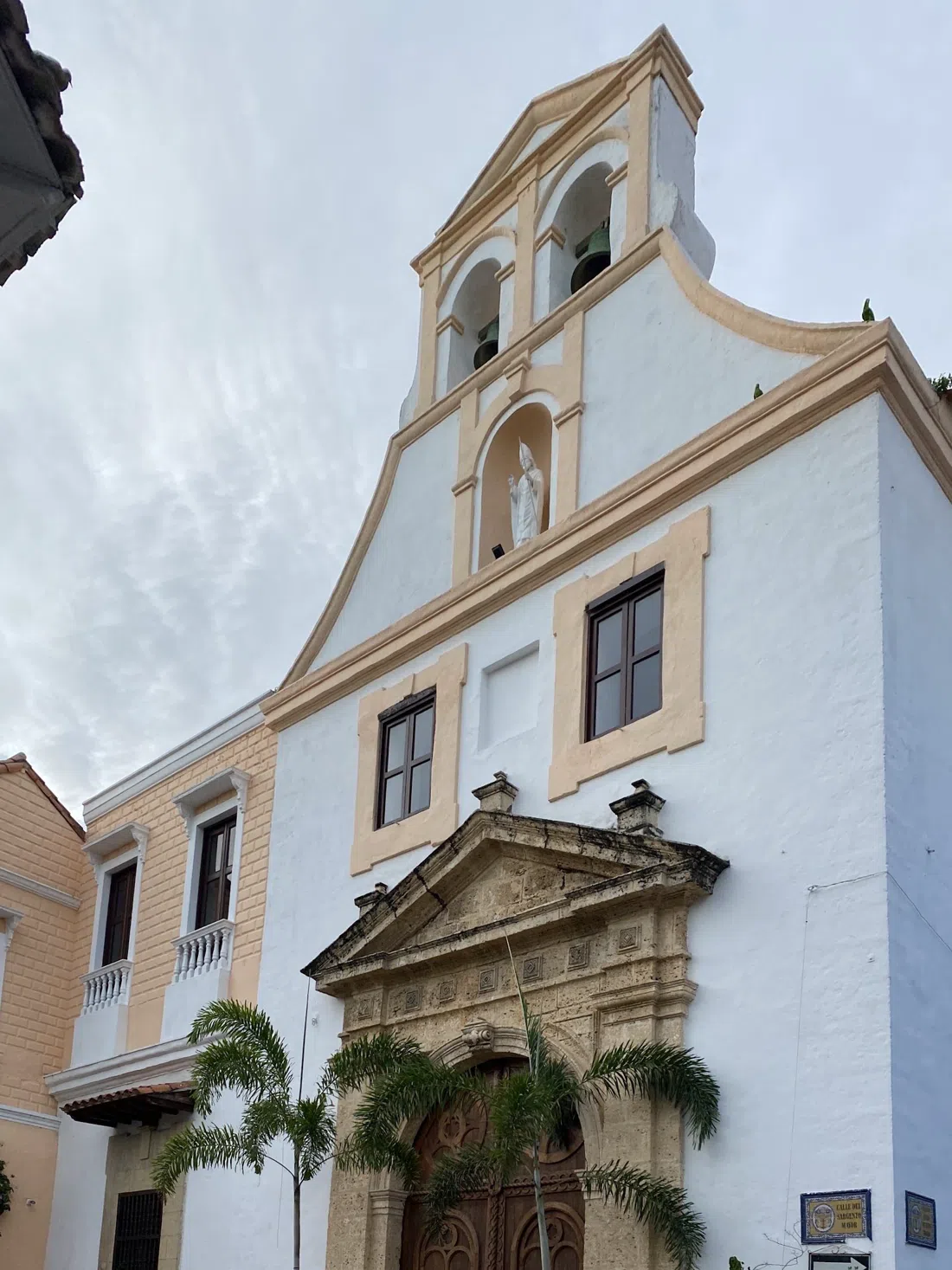
Iglesia de Santo Toribio de Mogrovejo (San Diego, five minutes) is the last colonial church built in the city and holds the only baroque altarpiece left in Cartagena, which is a remarkable thing to be able to see for free with nobody else in the room. Entry is free outside Mass, a donation is decent, shoulders and knees should be covered, and Sunday Masses are at 8am, 10am, 5.30pm and 7pm. Most tour routes skip it entirely.
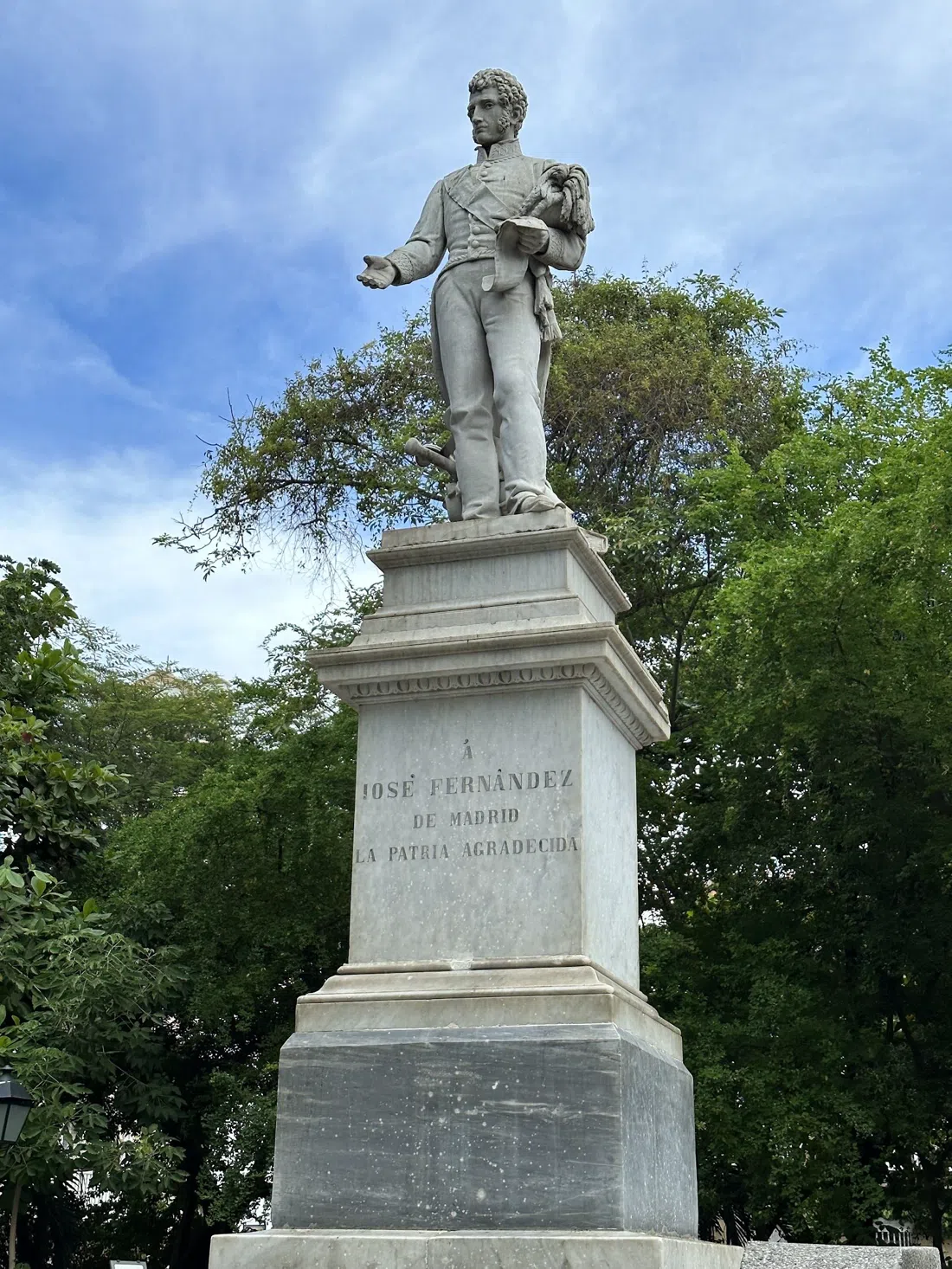
Plaza Fernández de Madrid (San Diego, two blocks away) is the everyday counterpoint and pairs naturally with the church on the same short loop. This is where the barrio actually sits out in the evening: benches, kids, dog walkers, no terraces angling for your attention. If you are herding a group, it is the easiest place in the quarter to regroup or wait.
Ábaco Libros y Café (San Diego, between the plaza and Plaza de Bolívar) belongs to the morning, not the night, but it is the civilised stop on the way back in. Coffee runs roughly COP 8,000 to 18,000, it opens Monday to Saturday 8am to 9pm and Sunday and holidays 9am to 9pm, and it is a real literary venue that hosts Hay Festival events, not a themed one. The room is small: pairs and threes, not parties.

Tickets, guides and the queue question
There is no ticket for Plaza de San Diego and there never has been. It is a public square: no gate, no queue, no opening hour, nothing to book. Anything you pay for here is a table, a drink or a craft stall.
The only thing worth booking is a guide, and only if you want one. The square is a standard stop on walking and street-food routes through the walled city, and a guided option is attached to this page. Those tours start from 52 USD per person and typically run six days a week, Monday to Saturday, so a Sunday plan needs to be self-guided. The strongest of them is rated 4.9 out of 5 from 1,486 traveller reviews, which is a fair signal that the format works, but it is a signal about the tour and not about the plaza. A guide will give you context on the convent and the fortifications you will not get from standing there. What a guide cannot give you is the square at nine at night, because by then the tours have finished.
If you would rather have the context without the group, walk the rampart at Santa Catalina in the late afternoon, read the plaques, then come back and sit. That costs nothing.
Access, rules and who it suits
The plaza itself is flat, open and step-free, and the paving is old but even enough. Everything in this guide is within a five to ten minute walk, which makes San Diego one of the easier quarters of the old city to cover on foot.
Couples and pairs get the best of it. The two places most likely to define the evening, La Cevichería and the Townhouse rooftop, are both small and both reward two people over six. Groups are perfectly well served, but they need to pre-arrange rather than wander: reserve at Juan del Mar, book Carmen early, call the rooftop, go through the hotel for El Coro, and use Plaza Fernández de Madrid as the meeting point instead of blocking a restaurant's frontage. Families are fine on the square at any hour; the bars are not children's places after about 8pm.
Two courtesies matter more here than elsewhere in the walled city. The convent is somebody's university, so keep your voice down near the doorway. The church is a working church, so dress for it and stay out during Mass.
Is it worth it
Yes, provided you know what you are buying, which is atmosphere and not a sight. If you arrive expecting a monument, you will be standing in a small paved rectangle wondering what you missed, and you will have missed nothing. If you arrive at half past five, walk the wall, eat when the light goes, and end up back on a bench at ten with the rehearsal still going behind the convent wall, it is the best-value evening inside the walls and one of the few that does not require a reservation to begin.
The people it suits least are travellers on a single tight day in the city, who should spend that day on the fortifications and Plaza de Bolívar instead. The people it suits most are anyone staying two nights or more, and anyone who has already done the headline squares and found them loud. For where to base yourself within walking distance, see the Cartagena hotel search; for the wider old city, the Cartagena guide covers the rest of the walled quarters.
Best time to go
The hour before sunset is the answer, and it is not a close call. The low light works on the balconies, the arts school empties into the square, and you are perfectly placed to eat at eight. Second best is late, after about nine thirty, when the terraces are down to their last tables and the plaza belongs to whoever is still sitting in it.
By time of day, in order: late afternoon for the walls and Las Bóvedas, before they shut for the day; 5pm to 7pm for the square itself; 8pm onward for dinner; 9pm onward for the bars, bearing in mind that Alquímico queues from about that time. Mid-morning is for coffee and the bookshop, not for the plaza, which is at its most crowded with assembling tour groups between roughly 9am and noon.
By day of week: weekday evenings are noticeably calmer than Friday and Saturday, when the bar traffic from elsewhere in the old city spills north. Sunday changes the arithmetic: La Mulata is closed, Masses run at Santo Toribio through the day, and the guided tours generally do not operate, so Sunday is a self-guided evening. It is also, for the same reasons, one of the quietest.
Year-round, this is an evergreen evening. Cartagena is hot and humid whenever you come; the practical seasonal rule is that a downpour empties the terraces fast, so keep the covered rooms at Juan del Mar or a bar with a roof as the fallback.
Practical notes
Getting there. San Diego is the northern end of the walled city and there is no way to drive comfortably into it. Taxis and ride-hailing drop at the gates, and you walk the last three to five minutes on cobbles. From the cruise terminal or the airport, agree the fare or use an app with a fixed price before setting off. Wear shoes you can walk uneven stone in after dark; the lighting is atmospheric and not much use.
Cash. Colombian pesos, and carry some. The restaurants and bars take cards; the square's coffee vendors, the craft stalls at Las Bóvedas and the church donation box do not. COP 100,000 to 150,000 in small notes covers incidentals for an evening, and small notes matter because change for large ones is a recurring negotiation.
Timing. Give the loop three to four hours from 5pm: wall, square, dinner, a drink. Compressed to ninety minutes it still works, with sunset on the ramparts and then a table on the plaza.
Budget. A cheap evening is easy: the square, the wall, the church and Plaza Fernández de Madrid are all free, lunch or an early dinner at La Mulata runs COP 16,000 to 40,000, and a vendor coffee is COP 3,000 to 5,000. A mid-range evening with a table at Juan del Mar and a cocktail somewhere lands around COP 150,000 to 250,000 a head. The top end, Carmen and then El Coro with the crypt, is comfortably more, and worth it once.
One last rule. Do not book the square. It is not bookable, it does not sell out, and the only thing that will stop you enjoying it is arriving at the wrong hour.