Cartagena-numret
Shopping Cartagena's Old Prison Vaults at Las Bóvedas
Antonio de Arévalo's bomb-proof vaults once held independence prisoners. Now the arches front craft shops, and walking the row costs nothing.
Av Sanne VermeerWalls, courtyards and the slower Cartagena

Antonio de Arévalo raised 23 bomb-proof vaults behind 47 round arches against the north wall between 1789 and 1798, the last colonial work built inside Cartagena's walled city. Later the city held independence prisoners in them, in the damp. Each arch now fronts a craft shop, and walking the colonnade costs nothing.
Walking the arcade at Las Bóvedas
Las Bóvedas (Cuartel de las Bóvedas, San Diego) is one long low white arcade with ochre-yellow trim, built into the city wall itself. Woven mochila bags and striped hammocks hang across the archways, and palm shadows fall over the flagstones in front of them.

Behind each arch sits a vault about the depth of a room, and almost all of them sell craft work. Caña-flecha hats and baskets, bags and hammocks fill most. Nobody takes a ticket at the arches. Entry is free, you pay only if you buy, and you settle the price at the vault door.
Nothing here is ticketed, so no queue forms, but coach and shore-excursion parties come through all day. The vaults are small rooms, and a large party ends up strung out along the colonnade.
ETCAR has been taking the vaults back through the courts since 2024. A handful have been handed over and emptied, so the number of trading shops shifts between visits, though the monument and the arcade stay open. Guided half-day circuits stop here seven days a week, and it is worth booking one ahead if your hours ashore are fixed.
Planera din resa till Cartagena
Aktuella priser från våra bokningspartner.
Gratis avbokning på många rum. Vi kan få provision när du bokar.
The wall either side of the vaults
Museo de las Fortificaciones (Baluarte de Santa Catalina) is the next thing along the wall, and the one place that explains how and why the vaults were built. The rooms are bare barrel-vaulted casemates inside a coral-stone bastion, where scale models of the harbour forts stand under spotlights, engineering panels line the walls and a cannon embrasure looks out to sea. Entry is $7,000 COP for adults and $4,000 COP for under-12s, open daily 8 a.m. to 6 p.m.
El Baluarte de la Gente (Baluarte de Santo Domingo) puts tables and low seating on the flat stone roof of a sea-facing bastion, blackened colonial cannons still pointing at the Caribbean and the sun dropping into the water behind the rampart. The bastion reopened to the public on 24 May 2025 under the Escuela Taller, staffed by its trainees, after the Consejo de Estado ordered the previous operator's contract liquidated and the bar there was evicted on 2 September 2024. Older guides still print that former tenant's name. The kitchen works 4 p.m. to 11 p.m. daily, $$.
Casa Museo Rafael Núñez in El Cabrero
Casa Museo Rafael Núñez (El Cabrero, five minutes out of the Santa Catalina gate from the vaults) is the two-storey white timber house where the four-time president who wrote the 1886 constitution lived and died. A wooden balcony wraps the upper floor behind green louvred shutters, and the house stands on the edge of the Cabrero lagoon under almond trees. Entry is free, the rooms are modest, and whatever small wait there is happens out on that balcony.

It closes Mondays. Tuesday to Friday it opens 9 a.m. to 5 p.m., Saturday and Sunday 10 a.m. to 4 p.m.
Eating around Plaza de San Diego
Plaza de San Diego is the small colonial square in the neighbourhood the vaults sit in: restaurant tables and umbrellas on two sides, ochre and pink facades, bougainvillea over the balconies, fruit carts round the edge and a horse carriage waiting. Kitchens on the square change hands quickly, so aim for the square and choose at the door, $$.

La Cevichería (Calle Stuart 7-14, San Diego) is a tiny corner storefront on a narrow street, blue-green walls, a chalk menu board and a handful of pavement tables under the balcony. Bowls of ceviche and grilled octopus come out of a kitchen that takes no reservations at any hour, so walking in is the only way in. It opens 1 p.m. to 10:30 p.m., $$$. More than two of you and you are better off splitting into pairs or coming off-peak.

Coffee, books and the convent bar
Ábaco Libros y Café has been open since May 2002, in a colonial corner room on a cobbled street between the vaults and Plaza de Bolívar. Dark-wood shelves run floor to ceiling, packed tight, with a small espresso counter, classical music and air conditioning. The room is small. Hours are Monday to Saturday 9 a.m. to 9 p.m., Sunday 3 p.m. to 9 p.m., $$.


Época Café Bar (Calle de Arzobispado, Cra. 5 #34-52) roasts in house, with beans from eight smallholdings in Tolima, Quindío, Nariño and Cundinamarca. Pour-over cones line a timber counter, hessian sacks of single-origin beans sit under it, and the roaster is in view. Coffee and coffee-rum tastings are served at that counter, which is where a group of six or more will spend the visit standing, $$.
El Coro Lounge Bar (Sofitel Legend Santa Clara, steps from Las Bóvedas) occupies the 400-year-old novices' choir of the old convent. High vaulted stone, dark carved wood and candlelight, a live Caribbean band in the corner, and mojitos on a marble counter as the house signature. Smart-casual is expected, and a scruffy walk-in gets a cool reception, $$$$.
Zenú gold on Plaza de Bolívar
Museo del Oro Zenú (Plaza de Bolívar) sets the woven caña-flecha hats and baskets sold in the vaults in the Zenú tradition they come from. The gallery is dark, with spotlit gold filigree ear ornaments and burial urns in glass cases, inside a colonial building on the arcaded square. Entry is free, nobody needs to book, an hour covers it, and the rooms are air-conditioned. It closes Mondays, opening Tuesday to Saturday 9 a.m. to 5 p.m. and Sunday 9 a.m. to 2 p.m.

La Serrezuela for fixed prices
La Serrezuela (Carrera 11 #39-21) is a restored circular timber bullring under a high glass roof, tiered wooden galleries above a sand-coloured arena floor ringed with shops and restaurants, and a fountain show on the hour. Here the price is on the tag. Entry is free, 10 a.m. to 10 p.m., to 11 p.m. Friday and Saturday, $$$. Lifts and air conditioning make it the easiest stop here for anyone who finds the arcade hot or the haggling tiring.

Rooftop bars near the vaults
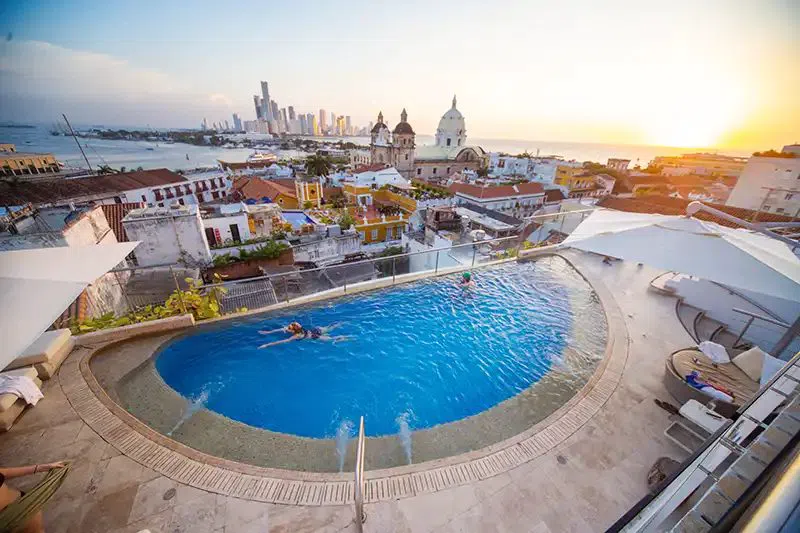
Alyzia Rooftop & Dining by Movich (Calle Vélez Danies 4-39) is a terrace and infinity pool above a republican-era hotel, with 360° sight of the terracotta rooftops, the dome of San Pedro Claver, the bay and the modern skyline beyond. The bar opens 11 a.m. to 11 p.m. and the kitchen from noon, $$$$. Non-guests use the bar and restaurant; the pool and jacuzzi are for guests. Dress is casual-chic.
Mirador Culture Bar sits on top of Hotel Torre del Reloj at the Clock Tower gate, where most port transfers drop and collect. The floodlit yellow Torre del Reloj fills the foreground, rooftops run behind it, and a live band plays on the open-air terrace, noon to 3 a.m., $$$. The Claustrum club runs Friday and Saturday only.

Castillo de San Felipe and La Popa
Castillo de San Felipe de Barajas is the other half of Arévalo's defensive system, a vast sand-coloured fortress stepping up a bare hill in stacked ramparts and long ramps, with narrow stone tunnels bored through the interior and the Colombian flag at the top. It opens 7 a.m. to 6 p.m. Tickets cost $38,000 COP full and $33,000 COP with Colombian ID. Students and ages 6 to 13 pay $16,000 COP, under-6s and over-62s enter free, and nothing is sold online in advance. Audio guides and official guides wait at the gate.

Convento de Santa Cruz de la Popa is the highest point in Cartagena, a white hilltop monastery with an arcaded courtyard smothered in bougainvillea and a bell tower. From the wall top the walled city, the bay and the lagoons sit in a single frame, the vaults included. Entry is $15,000 COP, open 8:30 a.m. to 5:30 p.m., and 30 to 45 minutes is enough. Go up by taxi or with a driver; walking the hill is not advised.

Arriving from the cruise terminal
Port Oasis Ecopark (inside the Cartagena cruise terminal) is a 10,000 m² garden holding more than 700 rescued animals of 74 species. Flamingos stand in a shallow pond, scarlet macaws and toucans fill walk-through aviaries, two of them named Birds of Prey and Wings of Colombia, and peacocks and iguanas wander loose on the paths. It is free, it was built to absorb whole ships' worth of passengers, and 20 minutes of it on the way back is enough.
Is it worth it
Las Bóvedas asks nothing of you but the walk, and the history sits in the stone rather than in any display. It suits a visitor who wants shade, a piece of Zenú weaving and the wall under their hand, with the fortifications museum next door to explain the rest.
Best time to go
Sunset tables at El Baluarte de la Gente go first, so claim one early in the service. Book Alyzia for sunset. Come to Plaza de San Diego about 6 p.m. for an outside table without waiting. ETCAR also runs free Sundays, when Castillo de San Felipe de Barajas costs nothing at the gate.
Practical notes
Mondays close the Casa Museo Rafael Núñez and the Museo del Oro Zenú, La Cevichería never takes a booking, and San Felipe sells only at the gate, so a Monday is best built around the arcade, the wall and the forts. See the Cartagena guide and the Cartagena hotel search.
Innan du åker
Do you pay to get into Las Bóvedas?
No. The arcade is an open-air public monument, free to walk, and nobody takes a ticket at the arches. You pay only if you buy something, and at the vault doors you haggle over the price.
What do the vault shops sell?
Craft work. Woven mochila bags and striped hammocks hang across the archways, and caña-flecha hats and baskets take up much of the rest. The Museo del Oro Zenú on Plaza de Bolívar explains the Zenú weaving tradition behind them, free and about an hour.
Are all 23 vaults open as shops?
Not always. ETCAR has been reclaiming the vaults through the courts since 2024, and a handful now sit empty, so the count of trading shops shifts between visits. The monument and the arcade stay open.
Can you visit on a shore excursion from the cruise port?
Yes. Guided half-day circuits take in Las Bóvedas seven days a week, and most port transfers drop and collect at the Clock Tower gate. Book ahead if your hours ashore are fixed.
What is worth seeing next to the vaults?
The next bastion along the wall, the Baluarte de Santa Catalina, holds the Museo de las Fortificaciones, which explains why the vaults were built: $7,000 COP for adults, $4,000 COP for under-12s. Casa Museo Rafael Núñez is five minutes out of the Santa Catalina gate and free, though it closes Mondays.